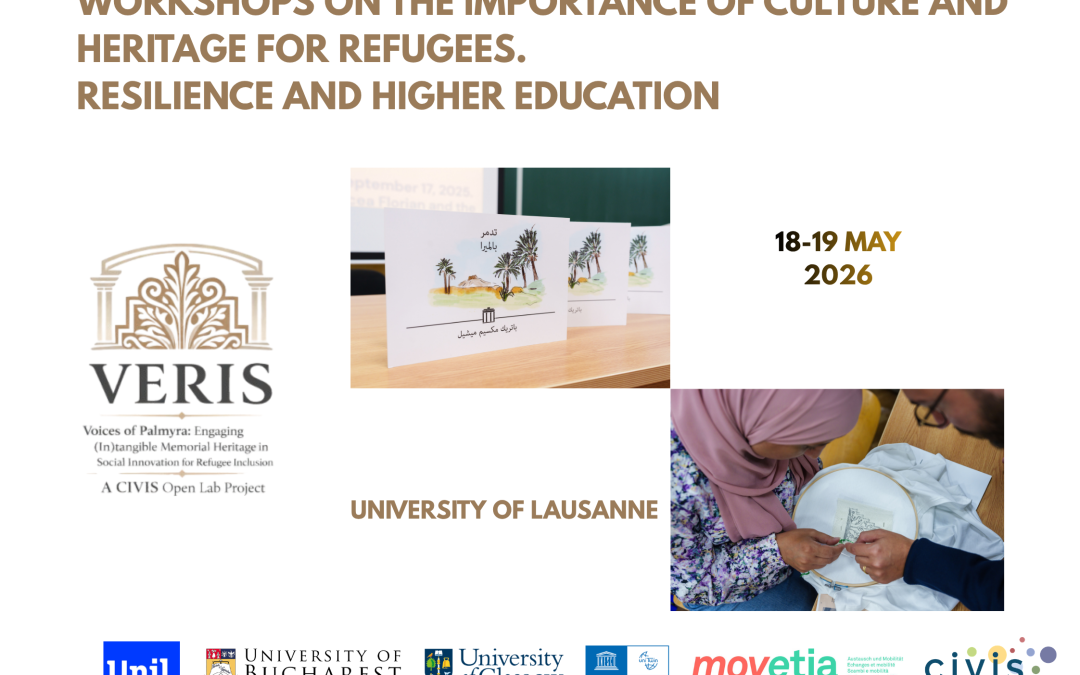
218945019564526
Faculty of Philosophy and the UNESCO Chair Participate in the International Dialogue on Cultural Heritage, Refugee Inclusion, and Social Resilience within the European VERIS – CIVIS Open Lab Project
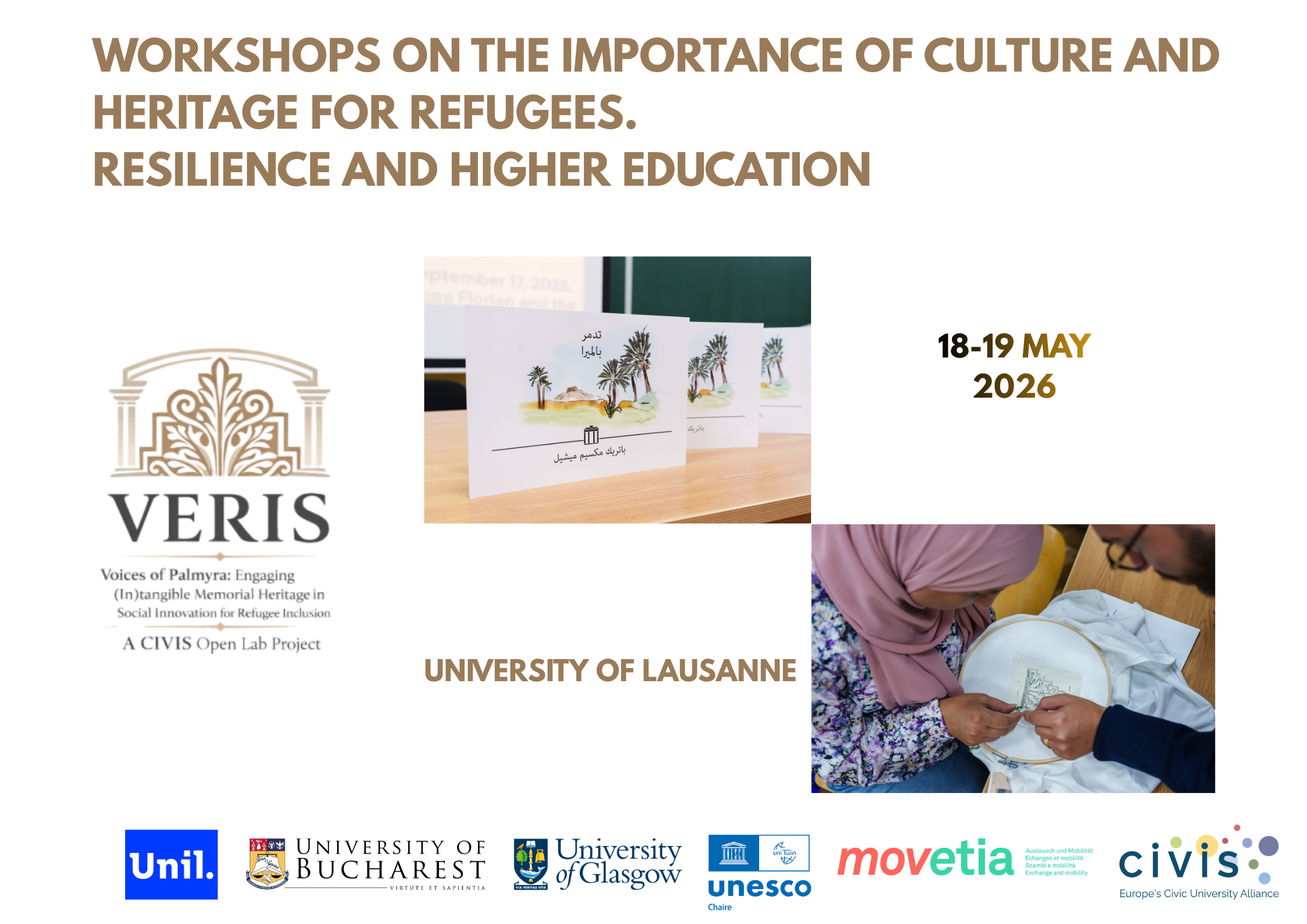
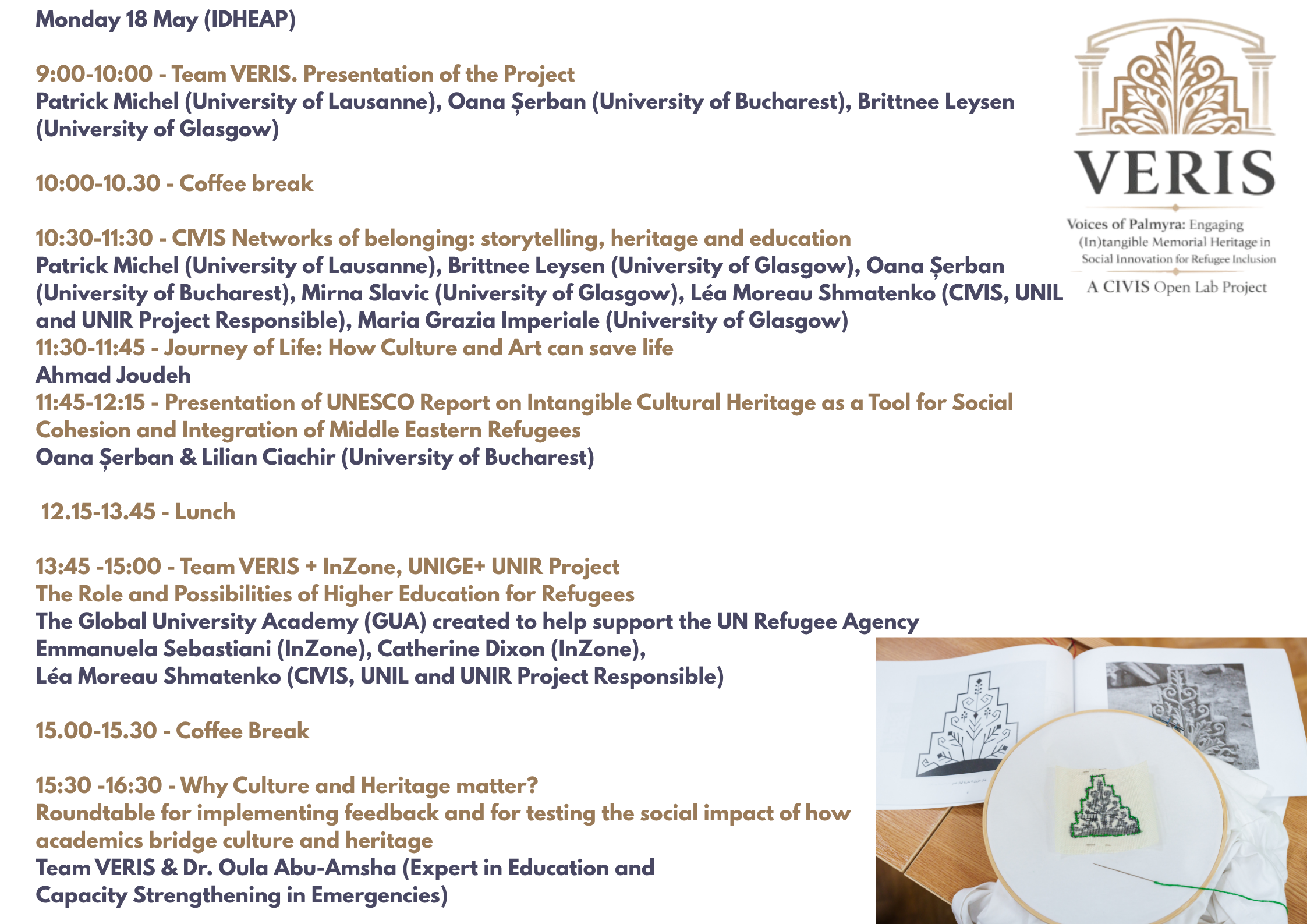
Faculty of Philosophy and the UNESCO Chair Participate in the International Dialogue on Cultural Heritage, Refugee Inclusion, and Social Resilience within the European VERIS – CIVIS Open Lab Project
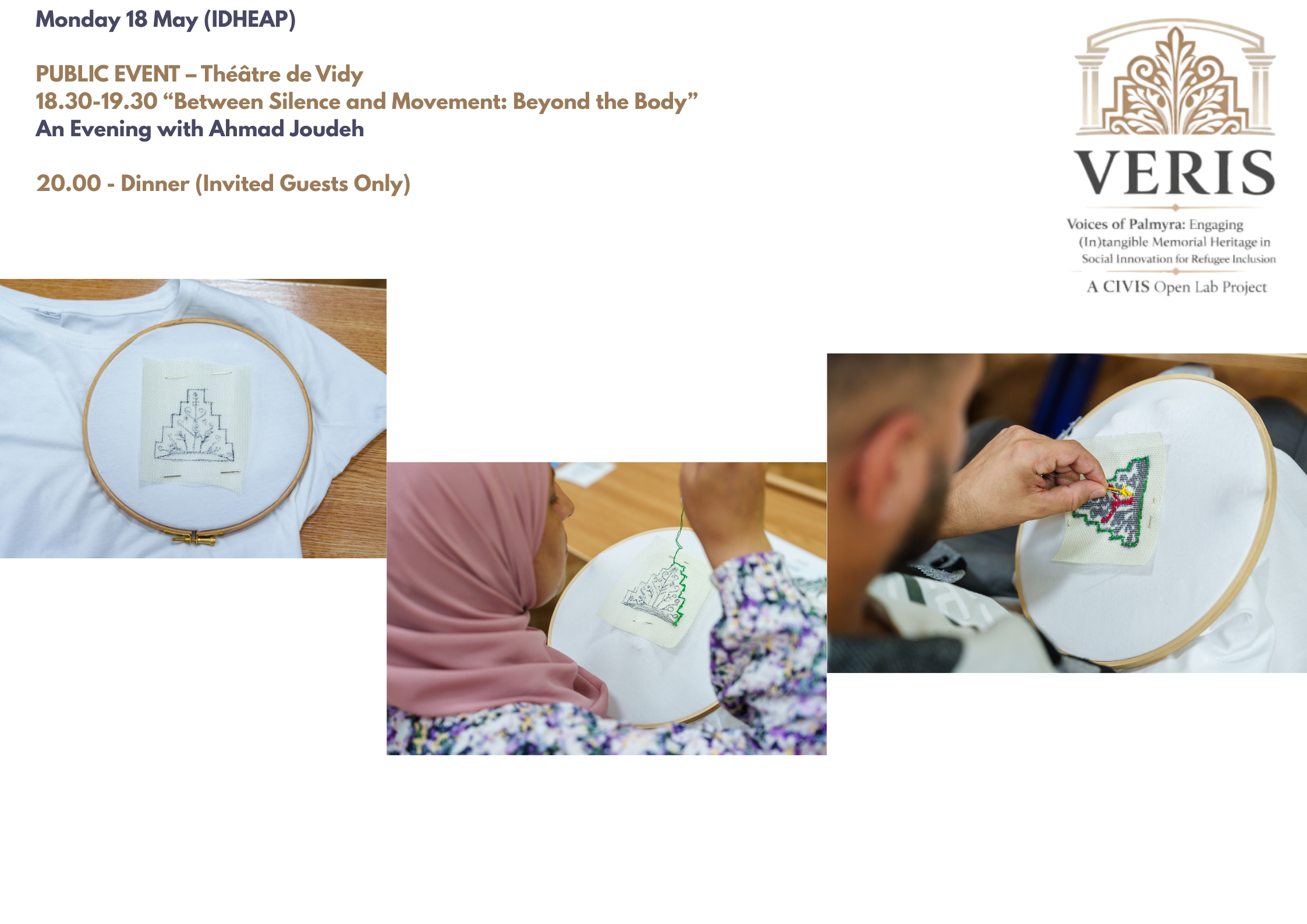
The Faculty of Philosophy and the UNESCO Chair take part in the international workshop organised by the University of Lausanne, presenting a report on the role of intangible cultural heritage in strengthening social cohesion and supporting the integration of Middle Eastern refugees.

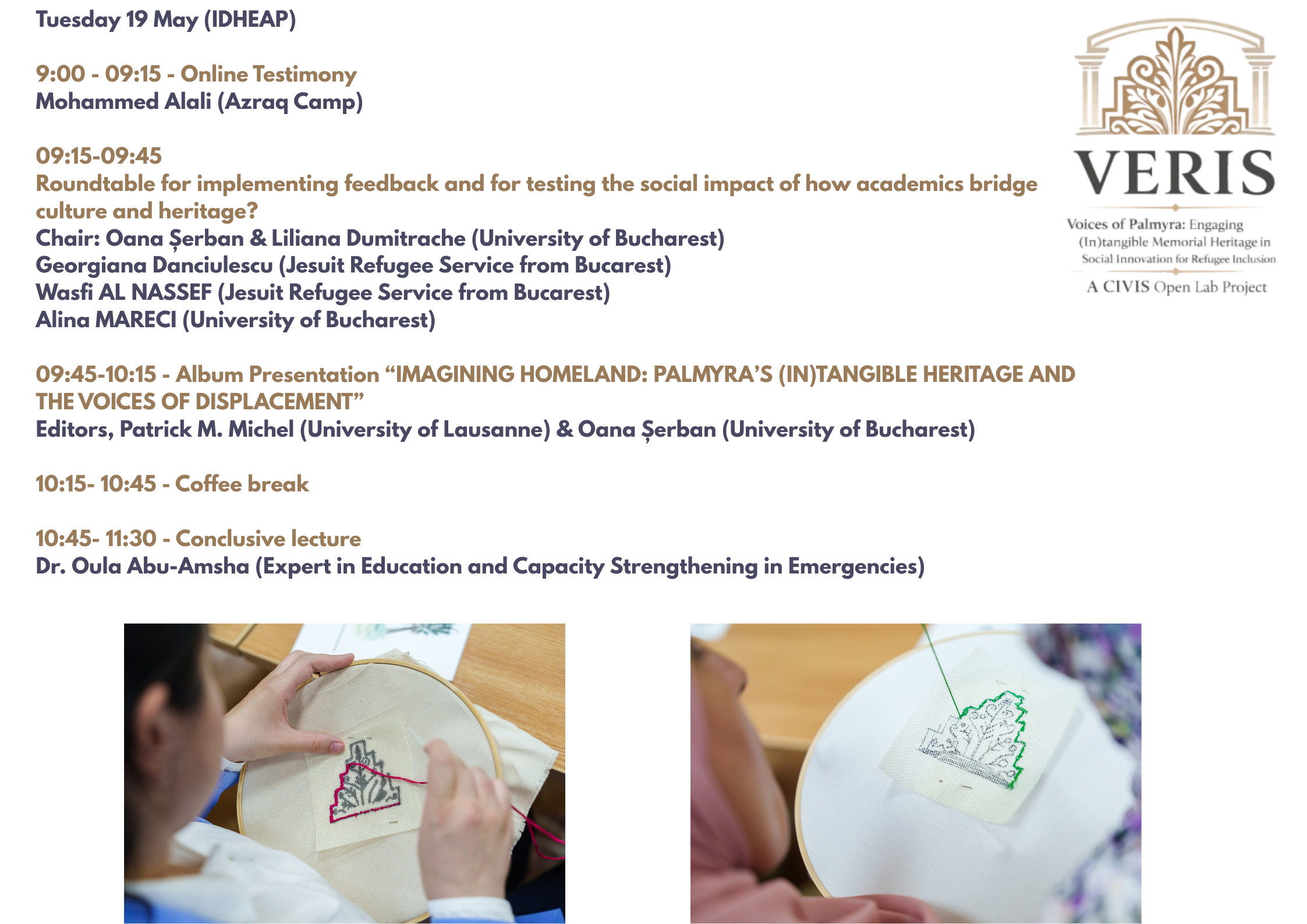
Between 18–19 May 2026, the Faculty of Philosophy of the University of Bucharest, through the UNESCO Chair in Interculturality, Good Governance and Sustainable Development, is represented at the international workshop “Workshops on the Importance of Culture and Heritage for Refugees. Resilience and Higher Education”, organised at the University of Lausanne within the framework of the European project VERIS – Voices of Palmyra, CIVIS Open Lab.

The event brings together researchers, international experts, and academic institutions concerned with the relationship between cultural heritage, education, inclusion, and resilience in contexts shaped by forced migration, social vulnerability, and challenges to community cohesion.

The report “UNESCO Report on Intangible Cultural Heritage as a Tool for Social Cohesion and Integration of Middle Eastern Refugees”, authored by Lecturer Dr. Oana Șerban and Dr. Lilian Ciachir, will be presented during the workshop and explores how intangible cultural heritage can become a tool for strengthening social cohesion, rebuilding a sense of belonging, and supporting refugee inclusion.

Drawing on the findings of the VERIS project, the report proposes a shift in perspective: from the mere symbolic recognition of the cultural heritage of vulnerable communities toward participatory models of cultural justice, in which refugees become active agents in the processes of defining, transmitting, and governing heritage.

The analysis highlights that forced displacement affects not only material security but also collective memory, cultural practices, and the continuity of community identities. In this context, intangible cultural heritage — traditions, rituals, narratives, and forms of expression — may contribute to rebuilding resilience, strengthening social belonging, and developing sustainable mechanisms of inclusion.

Participation in the Lausanne workshops forms part of a broader framework of research and international cooperation developed within the VERIS – Voices of Palmyra project, aimed at exploring the relationship between cultural heritage, memory, resilience, and the inclusion of communities affected by forced displacement.

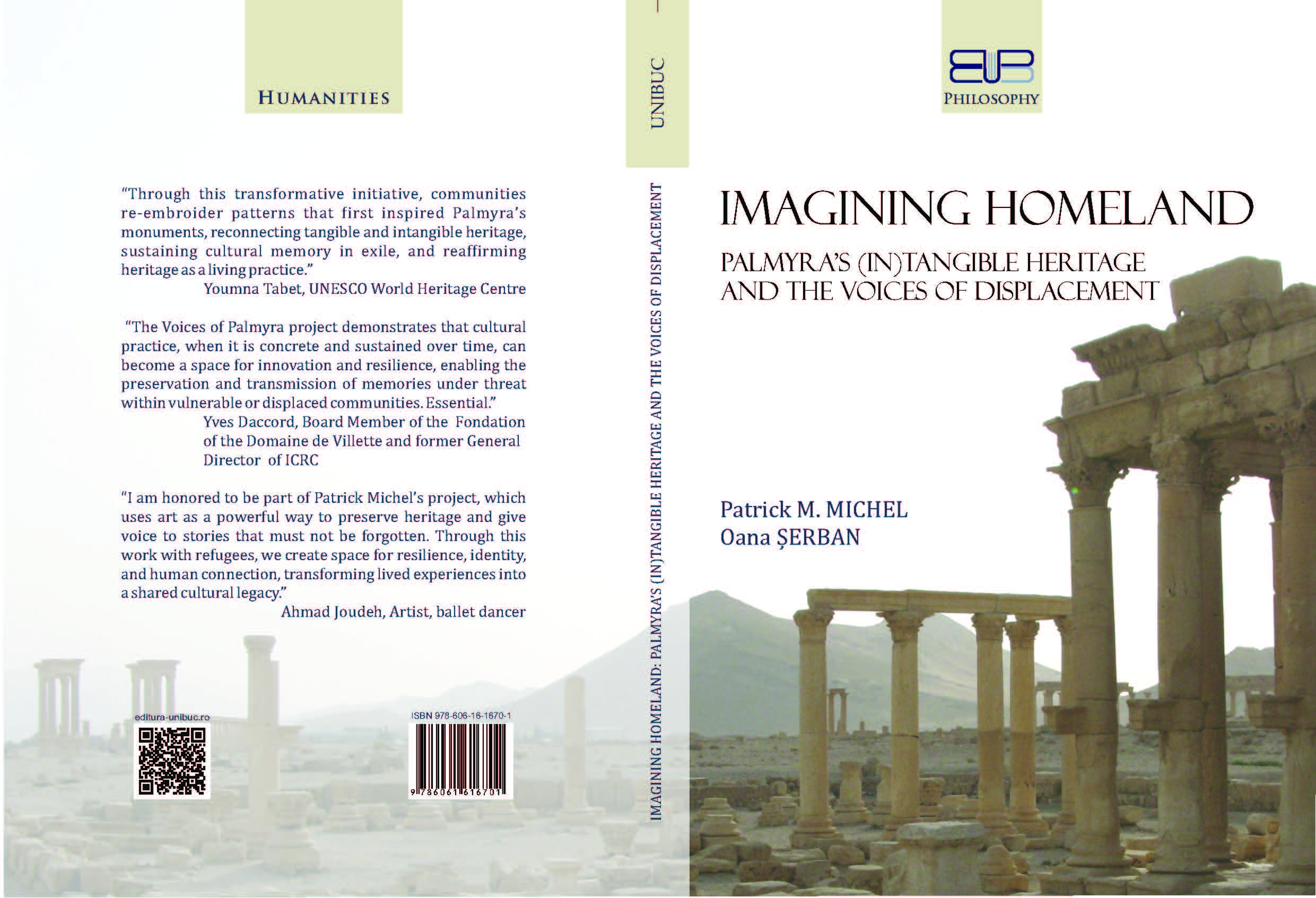
As a continuation of these activities, the photo-album volume Imagining Homeland: Palmyra’s (In)Tangible Heritage and the Voices of Displacement is scheduled for publication in June, co-edited by Lecturer Dr. Oana Șerban and Professor Patrick M. Michel (University of Lausanne). The work documents the practical and participatory dimensions of the research carried out under the auspices of the VERIS project, bringing together reflections on cultural heritage, memory, experiences of displacement, and mechanisms of resilience developed within vulnerable communities.

The volume illustrates how tangible and intangible heritage can become spaces for reconnection, belonging, and symbolic reconstruction for people affected by forced migration. The book, authored by Patrick M. Michel and Oana Șerban, will be published by the University of Bucharest Publishing Press and documents the voices of displacement alongside the (in)tangible heritage of Palmyra.

The participation of the University of Bucharest reflects its institutional commitment to intercultural dialogue, international academic cooperation, and socially impactful research, in line with the values promoted by UNESCO and the objectives of CIVIS – Europe’s Civic University Alliance.

Through involvement in international initiatives dedicated to cultural heritage and inclusion, as well as through the development of academic and editorial outcomes associated with the VERIS project, the Faculty of Philosophy and the UNESCO Chair reaffirm their commitment to promoting intercultural dialogue, resilience, and human dignity in increasingly complex global contexts.
The University of Bucharest and West University of Timișoara Join European Consortium for Heritage and Migration Project

The University of Bucharest and West University of Timișoara Join European Consortium for Heritage and Migration Project

The University of Bucharest and the West University of Timișoara have actively contributed to the preparation of a project proposal submitted under the HORIZON-CL2-2025-02-HERITAGE-02 two-stage call, coordinated by Swansea University (UK), together with partners from nine other prestigious European universities.

The project aims to explore and valorize the intangible cultural heritage of communities in migratory contexts, emphasizing its role in fostering social cohesion, intercultural dialogue, and local resilience. The proposed case study for Romania, titled “German Intangible Heritage in Romania – Community Revitalization and Identity Strengthening”, will investigate various forms of intangible heritage within German communities across different Romanian localities.

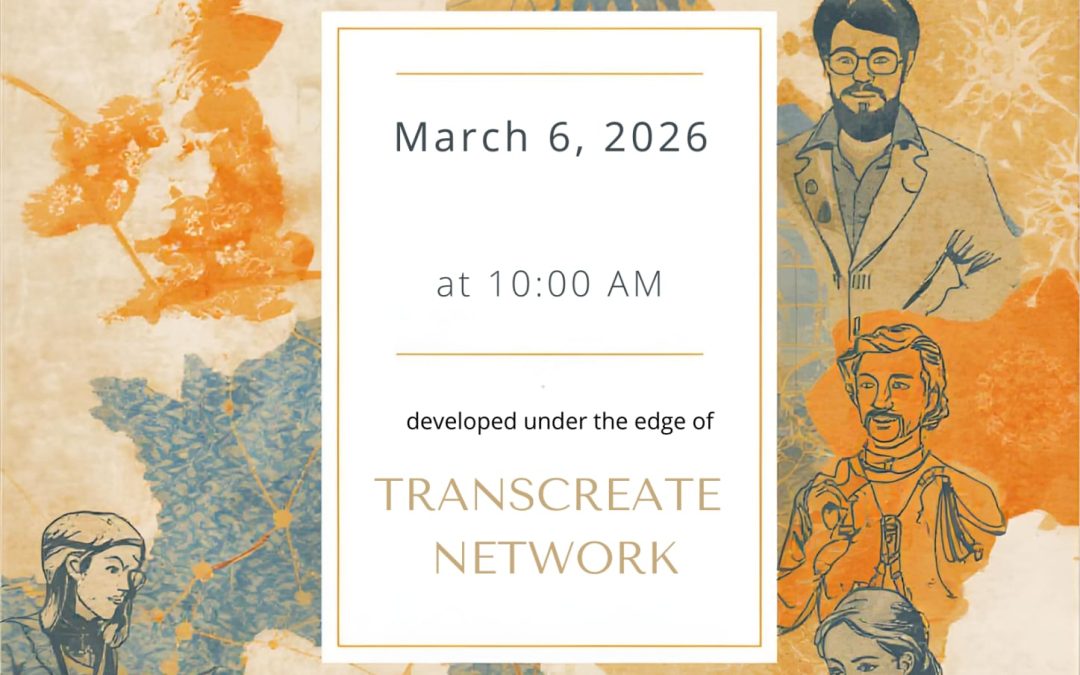
On March 6, 2026, at 10:00 AM (EET), the project team will host an online event to discuss the establishment of a Policy Lab within the TRANSCREATE project. The event will be accessible via meet.google.com/ypi-ycdr-xpx.

The event is organized with the support of the UNESCO Chair in Interculturality, Good Governance, and Sustainable Development within the Faculty of Philosophy, University of Bucharest, and in partnership with the Cultural Association “Istoria din Casă în Casă”.

The Policy Lab is designed as a participatory mechanism for co-creation, consultation, and knowledge transfer among researchers, community actors, public decision-makers, and cultural practitioners. While rooted in the Romanian context and its case study, the Policy Lab will systematically integrate data, comparative results, and lessons learned from all six European case studies, alongside educational resources developed within the project. The initiative also seeks to transcend national boundaries, facilitating the creation of a transnational network of stakeholders engaged in heritage preservation and community empowerment.

The first dialogue will take the form of a roundtable discussion, bringing together potential stakeholders representing both local and national levels, to collaboratively explore the scope, objectives, and mechanisms of the Policy Lab.

For more information, please contact:

For more information, please contact:

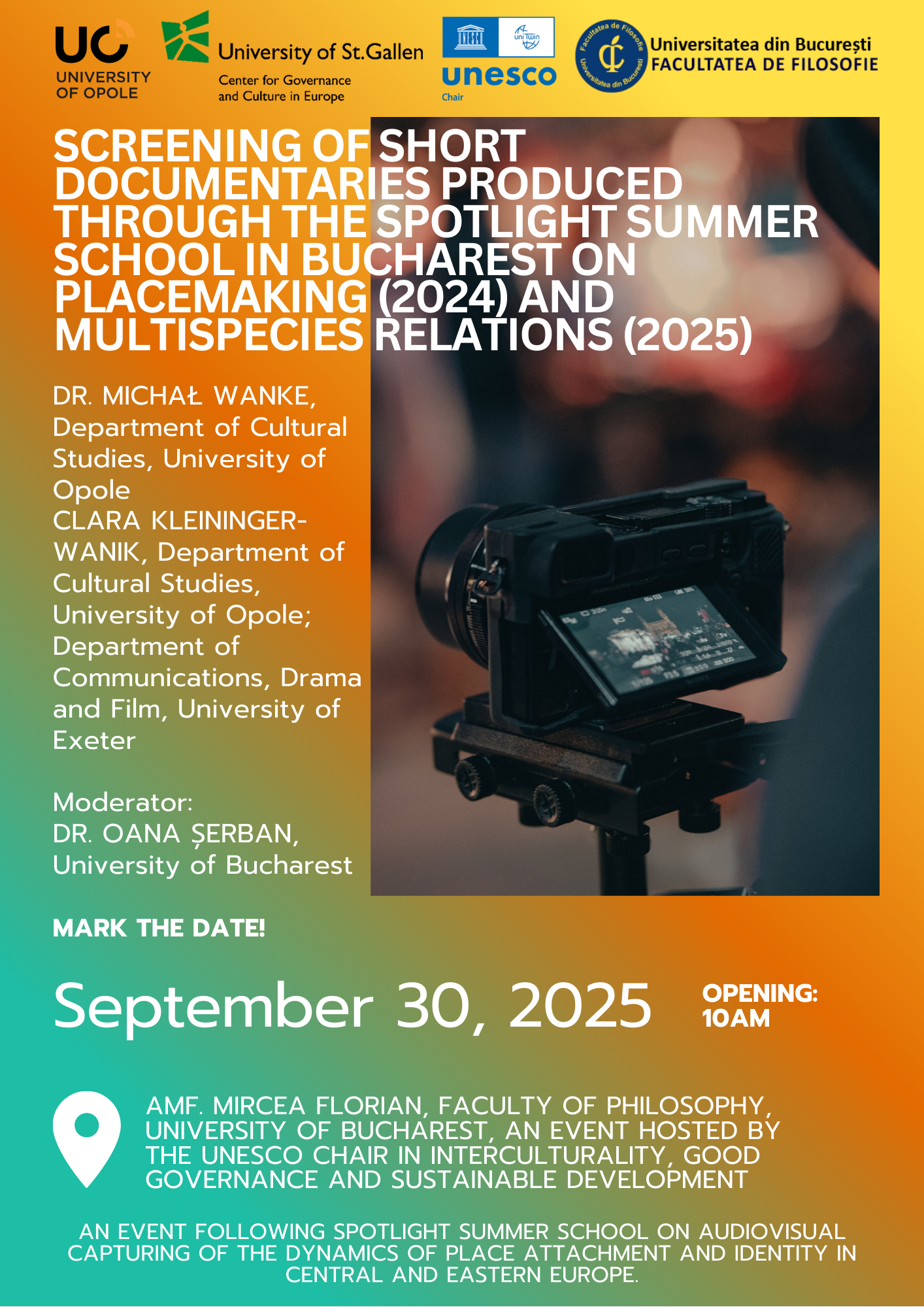
Screening of short documentaries produced through the SPOTLIGHT Summer School in Bucharest on placemaking (2024) and multispecies relations (2025)

Screening of short documentaries produced through the SPOTLIGHT Summer School in Bucharest on placemaking (2024) and multispecies relations (2025)

Screening of short documentaries produced through the SPOTLIGHT Summer School in Bucharest on placemaking (2024) and multispecies relations (2025).
by
dr. Michał Wanke, Department of Cultural Studies, University of Opole
Clara Kleininger-Wanik, Department of Cultural Studies, University of Opole; Department of Communications, Drama and Film, University of Exeter.
Moderator:
dr. Oana Șerban, Faculty of Philosophy, University of Bucharest.
An event hosted by the UNESCO Chair in Interculturality, Good Governance and Sustainable Development.

Save the date: September 30, 2025, 10AM.

The screening follows the international SPOTLIGHT Summer School on Audiovisual Capturing of the Dynamics of Place Attachment and Identity in Central and Eastern Europe. This program has been held in Opole (Poland), Budapest (Hungary), and twice in Bucharest (Romania), with financial support from the University of St. Gallen and co-hosting by New Europe College and UNATC (I. L. Caragiale National University of Theatre and Film).

Each year, students from across Europe collaborate in teams to develop short documentaries within a one-week intensive workshop. This event will present four short films created during the Bucharest editions of the Summer School. The screening (approx. 45 minutes) will be followed by a discussion (approx. 45 minutes) focusing on the conceptual and methodological dimensions of visual research in urban contexts. This year, the docs explore human and more-than-human relationships, multispecies encounters and urban ecology and we invite you to watch your city through their frames.
Please join us for a multimodal intellectual journey: to watch, feel, think, and talk together.

The films will be introduced and pitched by Dr. Michał Wanke, sociologist and Head of the Department of Cultural Studies at the University of Opole, and Clara Kleinigner-Wanik, documentary filmmaker and visual anthropologist affiliated with the University of Opole and the University of Exeter, where she is completing her PhD on film, multispecies relationships and Indigenous knowledge.

SESIUNEA DE DISERTAŢIE: SEPTEMBRIE 2025

SESIUNEA DE DISERTAŢIE: SEPTEMBRIE 2025

SESIUNEA DE DISERTAŢIE: SEPTEMBRIE 2025
  • Lucrarea de disertație finală va fi transmisă pe mail până la data de 01 septembrie 2025 profesorului coordonator, cu copie la lilian.ciachir@filosofie.unibuc.ro
  • Înscriere candidați: 02-05.09.2025 (în data de 05 septembrie până la ora 12.00)
  • Susținerea disertației în format fizic: 11.09.2025, ora 10.00, Amf. Mircea  Florian

Dosarul de înscriere va conține următoarele acte:

    • Fișa-tip de înscriere*
    • Declarația studentului privind originalitatea lucrării*
    • Fișa de lichidare* (absolvenții promoției 2025 vor depune fișa completată cu datele personale, iar Secretariatul se va ocupa de obținerea vizelor; absolvenții promoțiilor anterioare vor merge personal la Biblioteca Facultății de Filosofie și la Serviciul Social din campusul Grozăvești pentru a obține vizele necesare)
    • Formular de la Biroul Statistică (se va completa accesând site-ul absolventi.unibuc.ro și se va printa pdf-ul rezultat)
    • Certificatul de naștere, în copie
    • Certificatul de căsătorie, în copie (dacă este cazul)
    • C.I. sau pașaport, în copie
    • Diplomă de bacalaureat – copie certificată conform cu originalul
    • Diplomă de licență – copie certificată conform cu originalul
    • Documentul de recunoaștere a studiilor efectuate în afara României, conform prevederilor C.N.R.E.D. (dacă este cazul)
    • Lucrarea de disertație în format tipărit (cu coperta cartonată sau cu spiră) și în format electronic (pe suport USB/CD). Lucrările de disertație se vor încărca (deadline 05.09.2025) accesând cursul Internship: Research Activity – Elaboration of the Master Thesis. Accesul pe platforma moodle.unibuc.ro se face exclusiv cu ajutorul contului instituțional Microsoft 365** Urmare încărcării lucrării de disertație, platforma va genera automat raportul de similitudine. Primele două pagini care conțin procentul de similitudini vor fi printate și depuse de către absolvent împreună cu celelalte documente din dosarul de înscriere. Procentul de conținut plagiat acceptat în cadrul Facultății de Filosofie este 0%, iar procentul maxim de similitudine este de 30%.
    • Rezumatul sau Abstractul lucrării
    • Referatul profesorului coordonator (va fi transmis de către coordonatorul lucrării de disertație, prin intermediul formularului https://forms.gle/51w7S19jjiGfTBXq8, până la data de 09.09.2025).

    *fișa de înscriere, de lichidare și declarația se vor obține de la secretariatul facultății / de pe site-ul facultății.

    ** Încărcarea lucrărilor pe platformă pentru absolvenții promoțiilor anterioare va fi asigurată de Secretariat

    The International Conference „Stările generale ale filosofiei”, the 2nd edition, November 8-10, 2024

    The International Conference „Stările generale ale filosofiei”, the 2nd edition, November 8-10, 2024

    The Faculty of Philosophy at the University of Bucharest, in collaboration with the UNESCO Chair in Interculturality, Good Governance, and Sustainable Development, is hosting the second national conference, “Stările Generale ale Filosofiei” from November 8-10, 2024. This event marks two significant anniversaries: 160 years since the founding of the University of Bucharest and 330 years of philosophical education in the capital.

    As part of the program, a roundtable will explore UNESCO’s recent report advocating for philosophy’s recognition as a discipline foundational to “education for life.” This session builds on discussions from the international conference held in September, commemorating the 25th anniversary of the UNESCO Chair at the Faculty of Philosophy. This milestone highlights philosophy’s vital role in promoting ethical and sustainable educational frameworks aligned with global development objectives.

    Bringing together scholars, educators, and students, the conference reaffirms philosophy’s value not only as a historical academic pursuit but as a dynamic force for shaping sustainable and ethically guided societies.

    #PhilosophyEducation #UNESCOChair #UniversityOfBucharest #StărileGeneraleAleFilosofiei #EthicalDevelopment #AcademicConference #PhilosophicalHeritage #EducationalFrameworks #RomanianPhilosophy #AnniversaryEvent

    The International Conference – The Future of UNESCO Chapters: Intercultural Perspectives on Autonomy, Freedom and Independence. The 2nd edition: Philosophy as a School of Freedom

    The International Conference – The Future of UNESCO Chapters: Intercultural Perspectives on Autonomy, Freedom and Independence. The 2nd edition: Philosophy as a School of Freedom

    September 27, 2024

    The UNESCO Chair in Interculturality, Good Governance and Sustainable Development of the Faculty of Philosophy of the University of Bucharest is pleased to announce the call for papers for the 2nd edition of the 

    International Conference The Future of UNESCO Chapters: Intercultural Perspectives on Autonomy, Freedom and Independence. The 2nd edition: Philosophy as a School of Freedom.

    September 27, 2024

    This conference aims to bring together professors and researchers affiliated with UNESCO departments from Romania and from across Europe, in order to assess the human capital resources involved in the UNESCO network to support the 2030 Agenda for Sustainable Development in the field of culture and education.

    The theme of this year’s edition was inspired, on the one hand, by the 25th anniversary of the UNESCO Chair for Interculturality, Good Governance and Sustainable Development, within the University of Bucharest, and, on the other hand, by the 160th anniversary of the University of Bucharest and implicitly, of the Faculty of Philosophy, the co-founder of U.B.

    The two anniversaries mark the enduring educational traditions and solid organizational cultures that have over time strengthened the prestige of our academic community. In this context, it is our responsibility to evaluate the reception, at the level of the public sphere and contemporary mentalities, of the role that the Humanities field — and especially the discipline of Philosophy — holds in shaping rational, free and responsible citizens. The on-going debates on the relationship between culture and education are becoming increasingly thorny, focusing on the reform processes and also on the public policy improvements in these fields. In such situations, we notice how rarely the role of Philosophy is invoked — the same Philosophy which UNESCO recognizes as a “school of human freedom” (Philosophy as a School of Freedom – 2007) and to whom it dedicates, ever since 2008, a commemorative day every third Thursday in the month of November.

    Thus, we intend to investigate to what extent intercultural perspectives regarding fundamental values such as autonomy, freedom, and independence can be supported through a philosophical education in a global paideic space, by training citizens capable of understanding and respecting pluralism, diversity and equality between people. The subject of how philosophy upholds the education of cultural imagination, nurturing empathy and solidarity between individuals of different origins, together with the topic of various beliefs and histories will be approached through the lens of UNESCO’s stated objectives since 1998 — following a world conference dedicated to the differences between institutionalized philosophical education and philosophizing in the public space — up until today, when philosophy is employed as a form of life education through formal/non-formal/informal means.

    This conference is also a cultural follow-up to the Declaration for Philosophy in Paris, launched in commemoration of the 1995 UNESCO conference: we therefore seek to critically analyse what efforts have been made, at the level of European society, for the expansion of philosophical education, for the promotion of philosophical knowledge in different cultural communities, institutions and social circles, and for the imposition of Philosophy on the public agenda, as a discipline that can support the development of the relationship between culture and education.

    Since this is a conference organized by the UNESCO Chair of the Faculty of Philosophy of the University of Bucharest, the organizers, together with the partners, believe that, given their professional expertise, they can respond to UNESCO’s call to evaluate the connections between “creativity, innovation, critical thinking, resilience and empathy”[1] in establishing the society of the future in a post-pandemic society, focused on sustainable growth, on the digitalization of cultural capital and the stimulation of intercultural education, while advocating for “philosophy as a school of freedom.”

    The significant importance of examining the synergy between culture and education also stems from the current geopolitical and social context, in which migration, climate change and the collapse of representative and participatory democracies signal the need to respond to these clashes through the help of European communities of citizens who are ready to manage such challenges. Moreover, last year the Final Declaration of the UNESCO World Conference for Cultural Policies and Sustainable Development, MONDIACULT[2] 2022 was signed with the purpose of affirming culture as a global public good. The conclusions that arose after the previous edition of our conference emphasized the need for increased philosophical reflection on these three fundamental notions — culture, public good and education — an aspect we wish to support by creating a new framework for reflection and for critical thinking.

    Therefore, the conference proposed by the UNESCO chair of the Faculty of Philosophy of the University of Bucharest aims to evaluate the ways in which cross-sectoral, educational and cultural forms of cooperation between the UNESCO departments can respond to the MONDIACULT objectives and to the SDG objectives of the Sustainable Development Agenda for 2030.

    ______________________________________________________________________

    [1]   https://www.unesco.org/en/culture-education

    [2]   https://www.unesco.org/en/articles/mondiacult-2022-states-adopt-historic-declaration-culture?hub=701

    Contributions may address, but are not limited to, the following themes and topics:

    a) The role of intercultural communication in understanding the differences between autonomy, freedom and independence;

    b) Cultural conditioning of freedom;

    c) Combating social deprivation through culture;

    d) Contemporary democracies: the meanings attached to freedom and to social responsibility;

    e) Intercultural approaches to academic freedom;

    f) ‘Everyday Europeanhood’[1]: a matter of autonomy, freedom and independence?

    g) Philosophy, “the school of freedom”[2]: UNESCO’s role in protecting and promoting the Humanities field as a resource for shaping and educating contemporary democracies

    _____________________________________________________________

    [1] See Alexander Frame & Barbara Curyło (18 Oct 2022): Bringing Erasmus home: the European universities initiative as an example of ‘Everyday Europeanhood’,” Journal of Contemporary European Studies, DOI: 10.1080/14782804.2022.2134986

    [2] See the UNESCO report on Philosophy as a School of Freedom, https://www.unesco.org/en/articles/philosophy-school-freedom?hub=779

    • PhD. Viorel Vizureanu, Dean of the Faculty of Philosophy, University of Bucharest, Romania
    • PhD Oana Șerban, Executive Director of the Research Center for the History and Circulation of Philosophical Ideas, Faculty of Philosophy, University of Bucharest, Romania
    • PhD Lilian Ciachir, Coordinator of the UNESCO Chair, Faculty of Philosophy, University of Bucharest, Romania
    • Phd Candidate, Andreea Vlad, Faculty of Philosophy, University of Bucharest, Romania
    • Faculty of Philosophy, University of Bucharest, Romania
    • The UNESCO Chair in Interculturality, Good Governance and Sustainable Development, Faculty of Philosophy, University of Bucharest, Bucharest, Romania
    • CCIIF – The Research Center for the History and Circulation of Philosophical Ideas, Faculty of Philosophy, University of Bucharest, Bucharest, Romania
    SESIUNEA DE DISERTAŢIE: SEPTEMBRIE 2025

    SESIUNEA DE DISERTAŢIE: SEPTEMBRIE 2024

    SESIUNEA DE DISERTAŢIE: SEPTEMBRIE 2024
    • Lucrarea de disertație finală va fi transmisă pe mail până la data de 01 septembrie 2024 profesorului coordonator, cu copie la lilian.ciachir@filosofie.unibuc.ro
    • Înscriere candidați: 09.09.2024 – 11.09.2024 (în data de 11 septembrie până la ora 12.00)
    • Susținerea disertației în format fizic:

    – 16.09.2024, 10h30: Communication and INtercultural Studies

    – 17.09.2024: MBA & Intercultural Management (intervalul orar va fi anunțat la finele perioadei de înscriere)

      Dosarul de înscriere va conține următoarele acte:

        • Lucrarea de disertație în format tipărit (cu copertă cartonată sau cu spiră) și în format electronic (pe USB/CD). De asemenea, lucrarea de disertație se va încărca (deadline 01.09.2024) accesând cursul Internship: Research Activity – Elaboration of the Master Thesis. Accesul pe platforma moodle.unibuc.ro se face exclusiv cu ajutorul contului instituțional Microsoft 365. Urmare încărcării lucrării de disertație, platforma va genera automat raportul de similitudine. Procentul de conținut plagiat acceptat în cadrul Facultății de Filosofie este 0%, iar procentul maxim de similitudine este de 30%.
        • Rezumatul sau Abstractul lucrării
        • Referatul profesorului coordonator (va fi transmis de către coordonator prin intermediul formularului https://forms.gle/pyoxa3S4iqXfkfy79, până la data de 11.09.2024)
        • Fișa-tip de înscriere*
        • Declarația de asumare a răspunderii*
        • Fișa de lichidare* (absolvenții promoției 2024 vor depune fișa completată cu datele personale, iar Secretariatul se va ocupa de obținerea vizelor; absolvenții promoțiilor anterioare vor merge personal la Biblioteca Facultății de Filosofie și la Serviciul Social din campusul Grozăvești pentru a obține vizele necesare)
        • Formular Birou Statistică (se va completa accesând site-ul www.absolventi.unibuc.ro)
        • Certificatul de naștere – copie
        • Certificatul de căsătorie – copie (dacă este cazul)
        • C.I. sau pașaport – copie
        • Diplomă de bacalaureat – copie certificată conform cu originalul
        • Diplomă de licență – copie certificată conform cu originalul
        • Documentul de recunoaștere a studiilor efectuate în afara României, conform prevederilor C.N.R.E.D. (dacă este cazul).

        *fișa de înscriere, fișa de lichidare, declarația de asumare a răspunderii se vor ridica de la secretariat sau vor fi  descărcate de pe site-ul facultății

        The Economists’ Philosophy Day – A Journal of Philosophical Economics celebration of philosophical reflection in economic science

        The Economists’ Philosophy Day – A Journal of Philosophical Economics celebration of philosophical reflection in economic science

        In deference to the work of all inquisitive minds, past and present, who have embraced philosophical reflection to understand the consequential events for people’s wellbeing, the Journal of Philosophical Economics announces this call for the third edition of the

        Symposium on the Economists’ Philosophy Day, 21 Nov. 2024.

        In October 2005, the UNESCO General Conference proclaimed the third Thursday of November every year ‘World Philosophy Day’ recalling that ‘philosophy is a discipline that encourages critical and independent thought and is capable of working towards a better understanding of the world and promoting tolerance and peace.’

        It is in this spirit that J Philos Econ proposes to celebrate the Economists’ Philosophy Day by organizing online plenary sessions on scientific communication dedicated to the philosophical landmarks through which our science has been challenged, for better or for worse. For this edition, this call invites contributions in the theme of

        Democracy for sustainable life.

        Today, local societies, national societies and global societies are facing some serious challenges. Health problems such as pandemics and ecological problems such as climate change, loss of biodiversity, pollution of land, air and water can be considered examples. An institutional structure characterized by democracy as a game of policymaking and decision-making will likely be more successful in the resolution of these problems than dictatorship. Freedom of speech is a prerequisite for whistleblowers in relation to the most difficult challenges and various cases of corruption.

        But democracy is an issue as well in a university context. Departments of economics can be chosen as an example. A certain kind of economics, so called neoclassical theory, is in a close to monopoly position. Neoclassical economists tend to present their discipline as established and successful. In economics (and other social sciences), values, ethics, and ideology are always present and limiting attention to the ideology built into mainstream neoclassical economics is not compatible with democracy. New schools of thought or paradigms have appeared in response to new serious challenges. Ecological economics, in the sense of economics for sustainable development, is one example.

        Proposals of approx. 500 words are expected by September 27, 2024. After acceptance, authors are invited to submit the full version of their study for peer-review. Proposals will be sent to editor@jpe.ro.

        Organizers:

        Internship

        Internship

        No. Partner Institution Year of Collaboration Start
        1 Petroșani Municipal Library 2023 undetermined
        2 Neuroscience Laboratory, Faculty of Medicine 2023 undetermined
        3 Zumidian Corporation 2023 undetermined
        4 Eleutheria CADI Eleutheria Institutional Analysis and Development Foundation 2023 undetermined
        5 Liberal Professions Union of Romania 2023 undetermined
        6 Lion Communication Services SA Bucharest 2023 undetermined
        7 Popular Movement Party, Neamț Branch 2023 undetermined
        8 Exact Business Solution SRL 2023 undetermined
        9 Patris Noesis SRL 2023 undetermined
        10 RODBUN GRUP SA Bucharest 2023 undetermined
        11 DeRom Total Prahova 2023 undetermined
        12 Lawyer Cabinet Fercea Victor George Timisoara 2023 undetermined
        13 Somebody Cares Association, Argeș 2023 undetermined
        14 SCA Abraham and Associates 2023 undetermined
        15 School No. 7 Bucharest 2023 undetermined
        16 Christian Philanthropic Association St. Voievods Mihail and Gavril 2023 undetermined
        17 Rusu Cosmin-Adrian Individual Psychology Cabinet 2024 undetermined
        18 Zeep Solutions srl 2024 undetermined
        19 Iservices srl 2024 undetermined
        20 Association for Youth Sport Tourism 2024 undetermined
        21 Artvalue srl 2024 undetermined
        22 Innovation and e-Health Center, Carol Davila University of Medicine and Pharmacy 2024 undetermined
        23 RODBUN GRUP SA 2024 undetermined
        24 Neurony Solutions SRL 2024 undetermined
        25 Roman Catholic High School St. Iosif 2024 undetermined
        26 Humanitas Aqua Forte Foundation 2024 undetermined
        27 ROSHEN ONE SRL 2024 undetermined
        28 Child’s Phone Association 2024 undetermined
        29 Association for Research and Development of Rural Area Timișoara 2024 undetermined
        30 Măgurele Science Park Association 2024 undetermined
        31 International Justice Mission Foundation 2024 undetermined
        32 Aventure Service Romania 2024 undetermined
        33 DeRom Total 2024 undetermined
        34 Sportradar AG ST 2024 undetermined
        35 Michelle Laboratory SRL 2024 undetermined
        36 GE Medical System Romania SRL 2024 undetermined
        37 J.M. Expert Cont Consulting srl 2024 undetermined
        38 Child’s Phone Association 2025 undetermined
        39 Darchi Consulting srl 2025 undetermined
        40 Remis Dent Estet SRL 2025 undetermined
        41 Mindset Society Association 2025 undetermined
        42 Media Group Camina SRL radio Zu 2025 undetermined