International Conference „Multiculturality, Morality, and Public Affairs in the Digital Age” – June 15-16, 2026
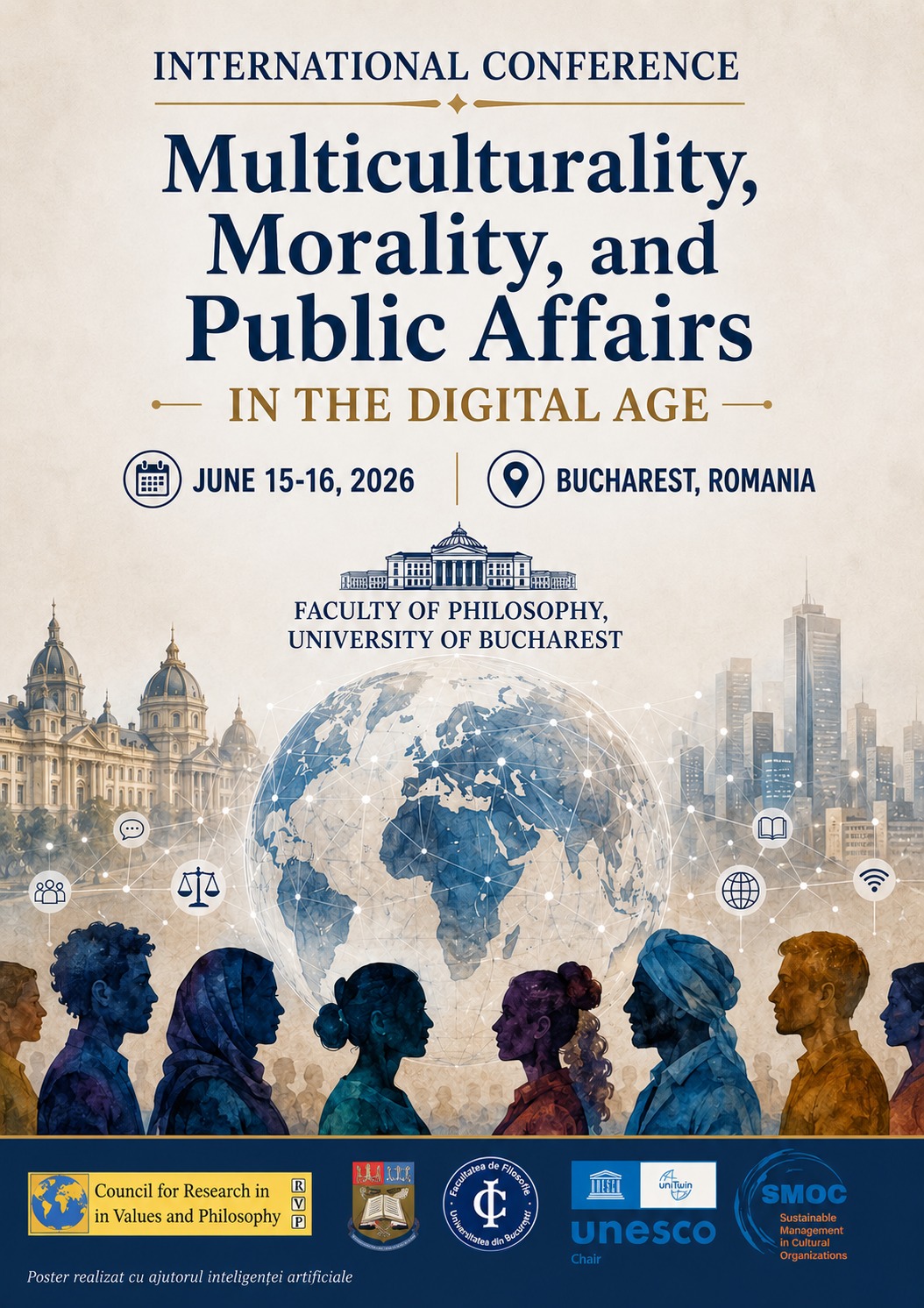
The Faculty of Philosophy of the University of Bucharest will host, on 15 and 16 June 2026, the International Conference „Multiculturality, Morality and Public Affairs in the Digital Age”. The event brings together researchers, philosophers, and specialists from across the world to explore the intersection of multiculturality, morality, and the public sphere in the digital era.
Organizers & Auspices
The conference is held under the auspices of the Council for Research in Values and Philosophy (CRVP), based in Washington, D.C., and is organized at the Faculty of Philosophy of the University of Bucharest with the support of the UNESCO Chair in Interculturality, Good Governance and Sustainable Development, and under the program SMOC – Sustainable Management in Cultural Organizations.
The principal organizers of the conference are:
- Professor Emeritus Mihaela Pop – Faculty of Philosophy, University of Bucharest
- Lecturer Dr. Oana Șerban – Faculty of Philosophy, University of Bucharest
- Gabriela Nistor
- PhD Candidate Romanița Vrânceanu
Opening Ceremony
The official opening of the conference will take place in the presence of the distinguished guests Dr. Bill Barbieri, Dr. João Vila-Chã and Dr. Hu Yeping, on behalf of the Council for Research in Values and Philosophy (CRVP), Washington, D.C., who will deliver the Welcome Address and officially inaugurate the proceedings, next to the Dean of the Faculty of Philosophy, Prof. Dr. Viorel Vizureanu, and the organizers, Professor Emeritus Mihaela Pop and PhD Lecturer Oana Șerban.
Programme & Themes
Spanning two days, the conference features four plenary sessions alongside dedicated panels for junior researchers and doctoral students, addressing the following themes:
- Moral Pluralism and Interculturality in the Digital Age – Democracy 2.0 and Its Axiological Discontents
- Religion and Multiculturalism – Spirituality, Recognition, and Faith
- The Challenges of AI in a Multicultural World – Uprootedness, Disconnectedness, and the Public Sphere
- The Future of Philosophy in the Age of AI – Identity, Critical Thinking, and Sensitivity
- Cosmopolitanism and Globalization – Plural Identities, Social Atomization, and Cultural Approaches
- A Multicultural Social Contract – Soft Power, Resilience, and Creativity
The conference unites academic voices from the United States, Italy, Denmark, India, Egypt, Greece, Bulgaria, Azerbaijan, Morocco, Nigeria, Romania, and beyond, offering a platform for genuine intercultural dialogue.
Cultural Programme
Following the closing ceremony, participants are invited to a two-and-a-half-hour guided walking tour along Victory Avenue (Calea Victoriei), with visits to the Coral Temple, Stavropoleos Monastery, the Royal Palace of Bucharest, and the Romanian Athenaeum.
Contact & Information
Faculty of Philosophy, University of Bucharest
Amphitheatre Mircea Florian, First Floor
Organizers: Prof. Emeritus Mihaela Pop mihaela.pop@filosofie.unibuc.ro | Lecturer Dr. Oana Șerban oana.serban@filosofie.unibuc.ro
Under the auspices of: Council for Research in Values and Philosophy (CRVP), Washington, D.C.
Multiculturality can be understood as a phenomenon that positively values the presence of diverse cultures within a state or region, attributing significance to a type of pluralism that prevents the dominance of certain cultures over others. In this context, multiculturality serves as an alternative to the homogenization tendencies induced by globalization. As a concept, multiculturalism allows for the exploration of various social groups’ cultures (such as women, linguistic minorities, youth subcultures, religious confessions, etc.) as well as of the cultures of immigration and ethnic minorities, thereby facilitating a better expression of their identities based on the principle of mutual social acceptance.
Morality pertains to a framework of thoughts and actions that guide individual and group life. It can be a code of norms, or a list of values, or a particular vision of nature, or a justification for certain frameworks. Morality concerns about what is considered good or bad. In terms of religious understanding, for instance, biblical norms for Christians are moral. While ethical theories constitute concepts, propositions, principles of moral attitudes that have been developed throughout the human history.
Public affairs involve efforts to manage relationships among public institutions so as to influence public policy and shape public perception. This includes governmental relationships, media communications, and the building of bridges to foster mutual understanding in the broader public and political landscape. Its primary goal is to influence public policies, public opinions, legal and media organizations through proper communication in order to promote general interest and the common good.
Contemporary society has been shaped by diverse cultural traditions, religions, and various political and socio-economic systems, etc. These elements have significantly contributed to the transmission of ideas, enriching the multicultural aspect of contemporary life and fostering mutual understanding among diverse communities. Through history, multicultural dialogue enhanced by scientific and philosophical ideas has enabled significant progresses in fields of mathematics, medicine, astronomy, and technology across the world. In recent decades, digital advancements have not only increased the speed of communication but also revolutionized all aspects of human life.
This pluralistic and interdisciplinary forum aims at exploring questions regarding how philosophical ideas, shaped by local contexts, transcend cultural, linguistic, and geographical boundaries. It intends (1) to understand how philosophical concepts or schools of thought can influence societies in the process of social progress; (2) to highlight the new paths generated by scientific discoveries and technological innovation; (3) to comprehend the meaning of morality in culture and public life; (4) to tackle the challenges that are brought about by the digital age.
Our contemporary digital age requires new ideas and insights to better understand the dynamic and challenges of new socio-political, moral, cultural, and religious situations. The constructive contributions of multiculturalism, morality, and public life can strengthen the social fabric and create a more inclusive future society. People may ask: What challenges does the digital age bring to these areas of interest? How has scientific progress changed the way people think and act? What are the fundamental ideas that govern our life and society? Can the digital age change these ideas? What are the similarities and differences in terms of mentalities, attitudes, or values throughout various transformative periods in human history?
This forum would like to invite scholars and thinkers who are interested in the following themes:
– Dialogue among cultures and religions in the transmission of philosophical ideas and ethical theories.
– Morality as a framework of values and norms that shape individuals and communities.
– New challenges generated by the 20th-century scientific progress and the 21st-century technological revolution.
– Socio-political issues arising from new scientific discoveries and information explosions.
– The impact of media and technology on the dissemination of philosophical ideas and education.
Abstract
Participants are kindly asked to submit their abstract of 300-500 words and a brief professional bio (in Microsoft Word or PDF) via the following form: https://docs.google.com/forms/d/1gYe4pclqTZr48l9U0sVzmtBiP5LCcHWj0I9V9pLp3Gk/edit by April 30, 2026. Questions and clarifications can be addressed to Prof. Dr. Mihaela Pop (mihaela.pop@filosofie.unibuc.ro; pop.mihaela.a@gmail.com) and Dr. Oana Serban (oana.serban@filosofie.unibuc.ro), as well as (cua-rvp@cua.edu).
The results of the evaluation will be known by May 15, 2026. The conference will be held in English. Well-developed, qualitative papers will be published by the Council for Research in Values and Philosophy in its publication series “Cultural Heritage and Contemporary Changes.”
Logistics
There will be no registration fee. Conference participants will cover their own costs of travels. For accommodation costs and additional information, please contact local organizers.
Contact
Prof. Dr. Mihaela Pop
Professor Emerita
Faculty of Philosophy
University of Bucharest
mihaela.pop@filosofie.unibuc.ro; pop.mihaela.a@gmail.com
and
Dr. Oana Serban
Lecturer
Faculty of Philosophy
University of Bucharest
oana.serban@filosofie.unibuc.ro