
Subject Cards

The UNESCO Chair in Interculturality, Good Governance and Sustainable Development of the Faculty of Philosophy of the University of Bucharest is pleased to announce the first edition of the International Conference The Future of UNESCO Chapters: Culture, Education and Sustainable Development: “Culture as a Global Public Good”.
[doc id=23851496]
This event aims to bring together professors and researchers affiliated to UNESCO Chairs across Europe, in order to assess the capacities of the human capital involved by the UNESCO networks to support the 2030 Agenda for Sustainable Development, in the field of culture and education.
According to UNESCO, “the relationship between culture and sustainable development has been the subject of discussions over three decades, culminating in four United Nations General Assembly resolutions on the topic that confirm culture’s role as being both an enabler and a driver of sustainable development, and that call for the mainstreaming of culture in the international development agenda.”[1]
UNESCO, being the specialized UN agency for culture, has the crucial responsibility to monitor the relationship between culture and sustainable development, but also to contribute to the realization of proposals for public policies that can support such synergy. Although UNESCO exercises this role through its policy and normative work at the global level, including its efforts to promote the role of culture in the implementation of the recently adopted 2030 Agenda for Sustainable Development and by supporting programs and projects at national level, it is time that representatives of UNESCO educational sectors get involved in the evaluation of the standards invested in the sustainable development of culture and education.
The scope of this conference is to provide insights into the relevance, effectiveness and coherence of UNESCO’s academic communities engaged to support the policies and priorities of sustainable development. Since it is a conference organized by the UNESCO Chair of the Faculty of Philosophy of the University of Bucharest, the organizers, together with their partners, given their professional expertise, are ready to respond to UNESCO’s call to evaluate the connections between “creativity, innovation, critical thinking, resilience and empathy”[2] invested in building the society of the future, in a post-pandemic society, focused on the digitization of cultural capital and the stimulation of intercultural education. The conference aims to investigate the ways in which cultural heritage and cultural-creative industries can be integrated into a range of cross-cultural educational approaches for training young people in an equitable environment.
The urgency of evaluating the synergy between culture and education also emerges from the current geopolitical and social context, in which migration, climate changes and failures of representative and participatory democracies reflect the need to respond to such challenges by educating communities of European citizens, capable of managing these phenomena. Moreover, last year, the Final Declaration of the UNESCO World Conference for Cultural Policies and Sustainable Development, MONDIACULT 2022, was signed, with the aim of affirming culture as a global public good.
Therefore, the conference proposed by the UNESCO chair of the Faculty of Philosophy of the University of Bucharest aims to evaluate the ways in which educational and cultural cooperation between UNESCO chairs can meet the MONDIACULT objectives and the SDG objectives for the Sustainable Development Agenda for 2023.
The objectives of this first edition are:
O1. To test the capacity of the academic environment involved by the UNESCO chairs to support the 2023 Agenda for Sustainable Development and the priority strategies established by the MONDIACULT Declaration for increasing the synergy between culture and education through UNESCO public policies
O2. To assess the coherence and effectiveness of UNESCO`s public policies for culture and development.
O3. To assess the way in which the digitization of cultural heritage and the challenges faced by the creative cultural sectors in a post-pandemic society support the affirmation of culture as a global public good according to the 2022 UNESCO MONDIACULT Declaration.
O4. To develop a network of researchers and teaching staff of UNESCO chairs who can work together for projects supporting the 2023-2030 Agenda for Sustainable Development, in the fields of culture and education.
Contributors are encouraged to submit their papers inspired by one of the following proposed topics:
Contributions (including an abstract of 300 words, title and a short professional bio in English) are expected to be submitted no later than the 1st of July 10tth of September 2023, at https://forms.gle/6YwJA3bWiGY7Vq257 Evaluation results will be communicated to participants before July 20 September 13, 2023.
The conference will be held at Bucharest, at the UNESCO Chair in Interculturality, Good Governance and Sustainable Development, on the 2nd of October 2023.
[1] UNESCO’s work on culture and sustainable development: evaluation of a policy theme, IOS/EVS/PI/145 REV.5 (REV.8 in Fre), 2015.

We are pleased to present the poster and agenda of the Economists’ Philosophy Day – A Journal of Philosophical Economics celebration of philosophical reflection in the economic science.
The event is organized by Professor PhD Valentin Cojanu (ASE) and PhD Lecturer Oana Șerban (Faculty of Philosophy, University of Bucharest), and supported by The Journal of Philosophical Economics, The Research Center for the History and Circulation of Philosophical Ideas (Faculty of Philosophy, University of Bucharest), the UNESCO Chair in Interculturality, Good Governance and Sustainable Development (Faculty of Philosophy, University of Bucharest) and the Bordeaux UNESCO Chair of Education, Training and Research for Sustainable Development.
In October 2005, the UNESCO General Conference proclaimed the third Thursday of November every year “World Philosophy Day” recalling that “philosophy is a discipline that encourages critical and independent thought and is capable of working towards a better understanding of the world and promoting tolerance and peace.”
You can see information at the bottom of this message for joining the meeting. Please feel free to disseminate the announcement among your colleagues, students, and lovers of wisdom.
Zoom meeting information
When: Nov 17, 2022 / Time – see Agenda
Register in advance for this meeting:
https://ase.zoom.us/meeting/register/tZErcO-spjsiH9I8Usbqtvv3FFLy2sb9EnFC
After registering, you will receive a confirmation email containing information about joining the meeting.


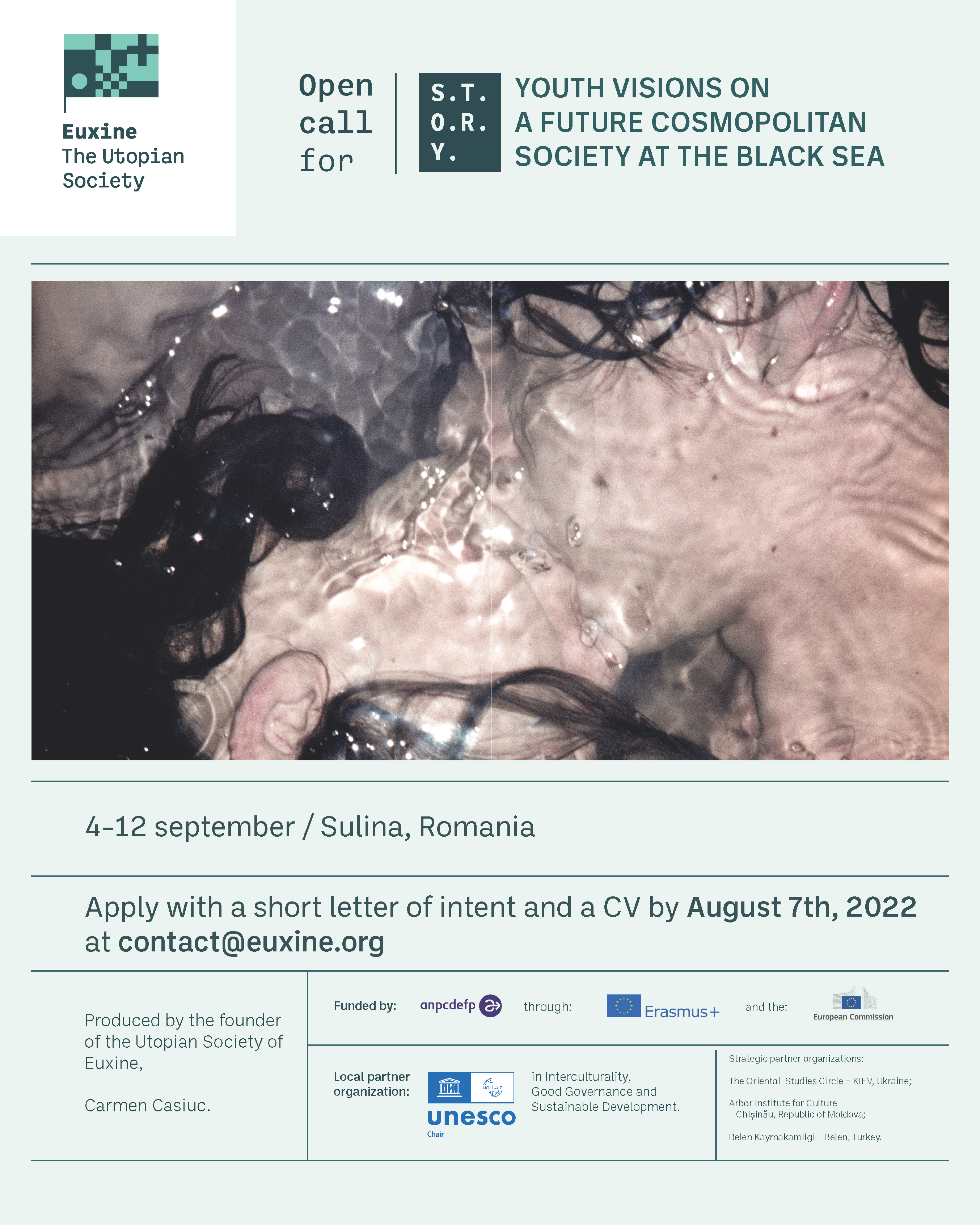

S.T.O.R.Y is an international workshop on institutional storytelling dedicated to young residents of Ukraine, Republic of Moldova, Romania and Turkey with ages between 18-30 years old and a background in Culture and the Arts, Humanities, Entertainment and Media, who wish to address systemic issues of social and cultural exclusion through the use of imagination and creative communication.
All traveling, accommodation and food expenses are covered by the organizers.
Apply with a short letter of intent and a CV by July 30th, 2022 at contact@euxine.org
Produced by the founder of the Utopian Society of Euxine, Carmen Casiuc.
Funded by ANPCDEFP through Erasmus+ and the European Commission.
Local partner organization: UNESCO Chair in Interculturality, Good Governance and Sustainable Development.Strategic partner organizations: The Oriental Studies Circle – KIEV, Ukraine; Arbor Institute for Culture – Chișinău, Republic of Moldova; Belen Kaymakamligi – Belen, Turkey.
People are storied beings and the narrative frameworks and narrative environments have a profound impact on the stories people can and do tell. Taking as a starting point one of the first European project for a modern cosmopolite society at the Black sea, The Utopian Society of Euxine invites youths from the realm of curatorial operators, art managers and cultural agencies to consider new frameworks that can support the development of a diverse cultural landscape at the shores of the Black Sea.
“Story Time of Real Youth” provides a framework of seven days for 25 participants who will explore the multicultural landscape that survived the transformation of Sulina throughout the 20th century from an exotic port at the junction of Eastern Europe and the Middle East into a ghost city.
Together with members of local ethnic communities, we will explore the imagination of the Black Sea, the history of migration movements and the international heritage present in Sulina through a variety of activities.
From city tours on bicycles to roleplay sessions, DIY reality hacks, intercultural nights and cooking demonstrations from invited community leaders, sailings on the Sulina Branch in the Danube Delta and Black Sea expeditions by boat, S.T.O.R.Y. is an immersive experience meant to help us imagine how a cosmopolitan future society could look like at the Black Sea.
For more information please visit the following link: http://euxine.org/#opencall
